Bangladesh managed to stem the downturn in its tax-to-GDP ratio last fiscal year with the proportion having edged up by 0.08-percentage point notwithstanding sluggish investment and economic activity, and waning purchasing power of both individuals and businesses.
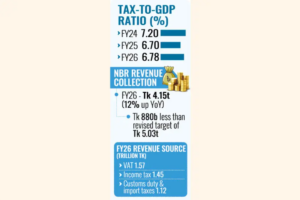
As per the provisional revenue-mobilisation data from the National Board of Revenue (NBR), the tax-to-GDP ratio stood at 6.78 per cent in FY2025-26, compared to 6.70 per cent a year earlier.
However, the ratio slipped last year from 7.20 per cent in FY24.
The calculation is based only on the NBR’s provisional tax-collection figures. The ratio may change once data on non-tax revenue and revenue collected by agencies other than the NBR are incorporated.
The NBR accounts for nearly 90 per cent of Bangladesh’s domestic revenue mobilisation meant for financing the national budget.
It collected Tk 4.15 trillion in revenue in FY2025-26, registering a Tk 880-billion shortfall against its revised target of Tk 5.03 trillion.
The shortfall against the original target of Tk 4.99 trillion stood at Tk 840 billion.
Officials say repeated setting of “unrealistic revenue targets” is putting pressure on tax officials and demoralising them when they fail to get to the goals.
A senior NBR official has said revenue mobilisation largely depends on economic activity, particularly development expenditure under the Annual Development Programme (ADP).
But the latest ADP-implementation data show Bangladesh recorded one of its lowest implementation rates last year-only 67.52 per cent of the annual allocation spent.
“Unless overall economic activity normalises, revenue collection will not pick up to the expected level,” the NBR official told The Financial Express.
Senior Research Director of the Centre for Policy Dialogue (CPD) Towfiqul Islam Khan thinks higher international prices of commodities, including fuels, helped generate additional revenue during the year.
He also points to disruption during the final quarter of FY2024-25 amid protests within the NBR over the proposed bifurcation of the revenue authority.
“However, the process or any systematic changes are missing, and the NBR is running at its traditional pace, posing challenges to meeting revenue targets in the future too,” he says.
Administrative loopholes must be addressed, he suggests, adding that it is unrealistic to expect comprehensive reform within a year, but the government needs to start the process immediately.
He also suggests the government reduce expenditure and prioritise spending, given the country’s persistently low tax-to-GDP ratio.
Economists say the marginal increase in the ratio is not significant, particularly as the appetite for domestic revenue is increasing amid a decline in foreign funding sources.
According to provisional NBR data, revenue collection increased by around Tk 450 billion from the previous fiscal year despite continued economic challenges.
Overall revenue collection grew by 12 per cent in FY2025-26.
The NBR, however, once again missed its revenue target, continuing a pattern seen in previous years.
Officials say weak development expenditure had a significant impact on domestic revenue mobilisation as a substantial portion of tax revenue comes from source taxes generated through government development activities.
At the same time, private-sector investment remained subdued, reflecting weak demand for credits and a cautious business environment.
Of the total NBR collection last fiscal year, VAT generated Tk 1.57 trillion, income tax Tk 1.45 trillion, and customs duty and import taxes Tk 1.12 trillion.
The modest improvement in the tax-to-GDP ratio, therefore, offers little comfort to policymakers, economists say, as Bangladesh’s fiscal needs to continue to rise while the capacity to mobilise domestic resources remains constrained.
Immediate-past NBR chairman Abdur Rahman Khan said it was challenging to mobilise higher revenue last year than the previous one amid economic hurdles.
“The government should consider providing sufficient budget and logistics for revenue mobilisation so that taxmen can work smoothly,” he suggests.
Source: https://thefinancialexpress.com.bd/economy/tax-gdp-ratio-edges-up-despite-weak-economic-activity