Bangladesh hopes to procure liquefied natural gas from next-door neighbour Myanmar in 12-hour transportation once a much-expected LNG sales-and-purchase deal is done, as the country faces exigencies of energy.
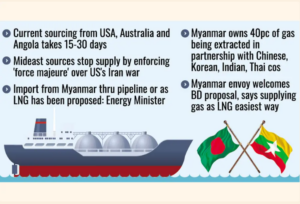
Currently, the country sources LNG from the United States, Australia and Angola wherefrom import consignments take 15 to 30 days.
It, however, takes around six to seven days to import the fuel from the nearest sources in Middle-Eastern countries.
But Bangladesh has not got LNG from its Mideast sources — QatarEnergy and OQ Trading — over the past several months as they have stopped supplying the gas by enforcing ‘force majeure’ since late February immediate after the war between the USA and Iran broke out.
“If both countries agree and settle price negotiations, Bangladesh will be able to import LNG from Myanmar within 12 hours — the shortest possible time to import the fuel,” Iqbal Hasan Mahmood, Minister for Power, Energy and Mineral Resources (MPEMR), told The Financial Express on Tuesday.
“We have proposed importing gas from neighbouring Myanmar through pipeline or as LNG,” he said.
“I made the proposal on Sunday after having the green signal from Prime Minister Tarique Rahman to import gas from our neighbour, which is a gas-rich country in this region, to resolve our mounting natural-gas crisis,” said the minister.
Myanmar has around 40 per cent of gas of its own in various oil-and gas-exploration projects being implemented under partnership with Chinese, Korean, Indian and Thai energy companies, from where the country can export LNG to Bangladesh, said the Bangladeshi minister.
The option was discussed during a meeting with Myanmar’s ambassador in Bangladesh, Kyaw Soe Moe, on Sunday at the secretariat.
As a close neighbour, Bangladesh is prioritising enhanced energy cooperation with Myanmar, he said, as industries, households and other consumers are in a crying need for gas amid a fuel crunch.
Importing LNG from Myanmar could further cut Bangladesh’s dependence on the volatile spot market, he added.
Bangladesh has significant domestic demand for natural gas, and the government is particularly interested in sourcing energy from Myanmar via pipeline in the long term and as LNG in the short term, Mahmood said.
Meanwhile, the Myanmar ambassador welcomed Bangladesh’s proposal and said supplying gas as LNG would be the easiest way for energy cooperation between the two bordering countries.
The envoy suggested that the matter could be reviewed at a Bangladesh-Myanmar joint technical-committee meeting.
The minister also extended a formal invitation to Myanmar’s energy minister to visit Bangladesh and expressed his own willingness to undertake a trip to Myanmar to discuss the gas import. Bilateral energy cooperation could play a supportive role in establishing the proposed China-Myanmar-Bangladesh corridor, which was discussed during the Bangladeshi prime minister’s recent visit to China, the energy minister said.
Currently, Myanmar exports gas to Thailand and China through pipelines.
Bangladesh is currently struggling to meet its gas demand amid elevated LNG prices, and as contracted long-term LNG suppliers continue to restrict scheduled cargo deliveries.
Due to disruptions to long- and short-term LNG supply, Bangladesh’s LNG spot cargo purchases this year are set to reach 41 by August, 39 of which have come after the start of the war in the Middle East.
In addition to limited contractual supplies due to the war in the Middle East, Bangladesh is currently facing a restriction in natural gas supply following the abrupt shutdown of operations at one of its two FSRUs on July 21.
Bangladesh’s overall natural gas supply fell to about 2,139 million cubic feet per day (mmcfd) on August 2, with 493mmcfd of regasified LNG, down from the pre-accident level of 2,642mmcfd, according to official Petrobangla data.
The country’s natural gas demand is about 4,000mmcfd, according to Petrobangla, which far outstrips the availability from domestic production and imports.
Gas-fired power plants are the worst hit, with electricity generation of about 2,500 megawatts being affected due to the FSRU disruption, state-owned Bangladesh Power Development Board (BPDB) Chairman Md Rezaul Karim said.
The gas-fired power plants are currently receiving about 680mmcfd, down from about 950mmcfd in the pre-accident period, he said.
The shutdown of the FSRU has reduced gas pressure in many areas, disrupting industrial production, too, he said.
Source: https://thefinancialexpress.com.bd/economy/bd-eyes-rapid-lng-import-from-next-door-myanmar