
Institutional reforms, stronger negotiating capacity and greater policy independence will determine Bangladesh’s next phase of development, economists and business leaders said today (2 August) at a discussion organised by the Policy Research Institute (PRI).
The remarks came during a seminar titled “Development Strategy and Policy Independence: Navigating Bangladesh’s Development Pathway,” which brought together economists, academics, business leaders and policymakers to discuss the country’s long-term development strategy.
Speaking as the featured speaker, Anisuzzaman Chowdhury, professor emeritus at Western Sydney University and former special assistant to the chief adviser of the interim government, said policy independence is fundamental to Bangladesh’s long-term economic development.
He said Bangladesh’s economic transformation was built on independent policy choices, including the privatisation initiatives introduced during former president Ziaur Rahman’s administration, the rise of the ready-made garment industry and agricultural integration.
However, reforms have increasingly been shaped by external pressures rather than national priorities. Citing South Korea and Vietnam, Anisuzzaman said their success stemmed from pursuing consistent, nationally driven policymaking.
He also stressed the need to strengthen social capital, empower civil society, remove vested interests and depoliticise public institutions to ensure effective governance and greater policy autonomy.
He expressed optimism that Bangladesh’s young population would increasingly drive demand for reforms as tightening global immigration policies make overseas migration more difficult.
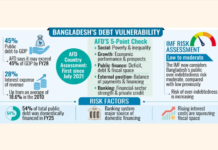
Moderating the discussion, Zaidi Sattar, chairman of PRI, said, “Bangladesh has significantly reduced its dependence on foreign aid, which now accounts for less than 2% of GDP, while more than 90% of its external public debt remains concessional, carrying an average interest rate of 1.3% and a 23-year repayment period.”
Other panellists also stressed the need for reforms. Kamran T Rahman, president of the Metropolitan Chamber of Commerce and Industry, said governance and reform conditions attached to World Bank and IMF financing largely reflect reforms Bangladesh should pursue regardless.
Fahmida Khatun, executive director of the Centre for Policy Dialogue, said stronger institutions and negotiating capacity would be essential as Bangladesh graduates from least developed country status amid an increasingly polarised global environment.
AKM Waresul Karim, dean of the School of Business and Economics at North South University, warned that rising public debt, expensive domestic borrowing and banking sector weaknesses pose long-term risks, calling for prudent fiscal management and financial sector reforms.
Selim Raihan, executive director of Sanem, said the outcomes of engagement with development partners depend largely on Bangladesh’s own negotiating capacity.
Md Rezwan Selim, vice-president of BGMEA, raised concerns over education quality and brain drain, while guest speaker Imran Matin said no public policy can be implemented independently of the country’s strong social and community forces.
Participants agreed that sustaining Bangladesh’s development momentum will require stronger institutions, policy consistency and broader engagement among policymakers, businesses, researchers and civil society.
Source: https://www.tbsnews.net/economy/bangladesh-must-strengthen-policy-independence-sustain-growth-say-experts-1504741