The Daily Star
Fitch Ratings has revised its outlook on Bangladesh to “negative” from “stable”, citing rising external financing pressures and macroeconomic vulnerabilities linked to exposure to the Middle East conflict.
The global ratings agency kept Bangladesh’s long-term foreign-currency issuer default rating (IDR), which measures the ability to service foreign-currency-denominated debt over time, unchanged at B+.
“The Middle East conflict creates significant downside risks, particularly through the supply and cost of energy imports and remittances,” Fitch said in a statement yesterday.
Nearly half of the country’s remittances come from the Middle East, while crude oil and petroleum products together account for almost 15 percent of imports, worth about $10 billion in 2025.
“Strong remittances so far in financial year 2026 provide near-term support to external finances; however, uncertainty regarding the conflict’s duration poses substantial downside risks,” said Fitch, an American-British credit rating agency.
In July 2025, S&P Global, another member of the “Big Three” global credit rating agencies, said Bangladesh’s long-term outlook was stable and kept the country’s foreign and local currency sovereign credit ratings at B+.
Fitch, which kept its outlook on Bangladesh stable in May last year, said in the latest statement that limited progress in reforms to address weaknesses in the policy framework, public finances and financial sector, along with continued weak institutional governance, would gradually erode the economy’s capacity to absorb shocks.
“The ratings reflect moderate government debt and access to concessional external financing, balanced against a still relatively weak external liquidity position, governance standards lower than those of peers, significant financial sector challenges, and lagging structural metrics compared with peers,” Fitch said.
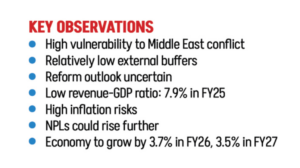
It said Bangladesh has relatively low external buffers, with foreign exchange reserves standing at $29.5 billion in March 2026, equivalent to about four months of external payments.
The agency cautioned that wider current account deficits, stronger domestic demand for foreign currency or reduced external financing due to uncertainty around the IMF programme could renew pressure on the currency and reserves.
“Reform outlook uncertain,” it said, citing rising uncertainty over the new government’s willingness to push through changes.
Fitch said Bangladesh’s low government revenue-to-GDP ratio remains a key fiscal weakness, falling to 7.9 percent in fiscal year 2024-25 from 8.3 percent a year earlier.
Revenue collection is constrained by large tax exemptions, weak tax administration and poor compliance, contributing to wider fiscal deficits. The agency projected a budget deficit of 3.6 percent of GDP by 2027.
“Inflationary pressures are high, due partly to a shortage of essential commodities,” Fitch said, adding that price rises in petroleum and liquefied petroleum gas could fuel inflation further.
The agency expected that overall inflation would remain around 9 percent in fiscal year 2027.
Bangladesh economy is projected to grow by 3.7 percent in FY26 and 3.5 percent in FY27.
“Prolonged high energy prices and rising global uncertainty could further weaken growth. Ready-made garment exports are declining due to redirected orders following reciprocal tariffs, weaker global demand, and higher domestic production costs.”
Fitch said banking sector vulnerabilities remain elevated, particularly among state-owned banks, and warned that the non-performing loans ratio could rise once regulatory forbearance measures are withdrawn, creating contingent liability risks.
“This remains a source of contingent liability if credit stress intensifies.”
The agency expects Bangladesh’s public debt to stabilise at about 38 percent of GDP over the medium term. However, it mentioned that risks remain from potential liabilities in the banking sector, debt of state-owned enterprises and higher borrowing costs.
Fitch also noted that the interest-revenue ratio has been rising and reached about 29 percent, more than double the median of 14 percent as of the end of 2025, adding further pressure on public finances.
Source: https://www.thedailystar.net/business/economy/news/fitch-revises-bangladesh-outlook-negative-amid-middle-east-fallout-4175171