The Daily Star
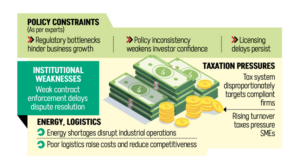
- Regulatory bottlenecks and inconsistent policies stifle investment
- Weak contract enforcement and legal risks deter investors
- Urgent energy and logistics reforms needed for growth
Bangladesh’s business climate is being held back by regulatory bottlenecks, inconsistent policies, weak trust, and institutional inefficiencies, which are reducing investment potential and weakening long-term investor confidence, experts said at a dialogue yesterday.
The remarks were made at a discussion titled “Business climate dialogue on improving the investment climate: why it is critical for the new government priorities the upcoming national budget”, organised by the Metropolitan Chamber of Commerce & Industry Dhaka (MCCI) with Policy Exchange of Bangladesh at its auditorium at Police Plaza in Gulshan.
“The real challenge is not competition but entering the market itself. Firms must be ready for a long-term commitment because operational hurdles — from licensing delays to compliance burdens — can discourage even established companies,” said Zinnia Huq, chief financial officer of Unilever Bangladesh.
She said regulatory approvals often take months due to weak coordination among agencies, which leads to conflicting requirements, such as dividend remittance rules clashing with tax approvals.
She added that legal risks remain high as cases move through multiple channels, reducing predictability.
Huq further said that labour regulations are uncertain because interpretations often change and are sometimes applied retrospectively, making business planning difficult.
Tax administration, she added, sometimes raises large initial claims against compliant firms, which are later adjusted after review.
Nuria Lopez of the European Union Chamber of Commerce in Bangladesh said the main issue is not a lack of opportunity but weak investor confidence, adding that an unfriendly business environment and unclear policy direction continue to discourage foreign investment.
She also said that taxation places additional pressure on businesses, as authorities often rely heavily on compliant firms, especially multinationals, creating an uneven playing field.
Sector-specific lobbying limits competition and makes it harder for new firms to enter the market, she added.
Lopez further said that institutional weaknesses, energy shortages, and the lack of a clear investment roadmap are increasing uncertainty, warning that Bangladesh could fall behind regional competitors.
Margub Kabir of Margub Kabir and Associates said trust is central to investment decisions and depends largely on dispute resolution.
He said Bangladesh remains weak in enforcing contracts and has previously ranked among the lowest globally due to a slow and overloaded judicial system.
Kabir also said arbitration, which foreign investors often prefer as it helps avoid court delays, offers limited benefit. This is because enforcing arbitral awards still requires going through the same lengthy court process, which reduces their effectiveness.
He added that the main problem is not a lack of laws but weak implementation, stressing the need to simplify procedures, appoint specialised commercial judges, and introduce faster enforcement systems.
Mahmud Hasan Khan, president of the Bangladesh Garment Manufacturers and Exporters Association (BGMEA), said improving the business environment must begin with core infrastructure reforms.
He said a reliable energy supply is the most urgent need, especially for industries moving into higher-value production. He added that man-made fibre manufacturing requires uninterrupted power, as even short outages can stop production completely.
He also pointed to inefficiencies in key logistics routes, including the Dhaka-Chattogram highway and port operations, which are increasing costs and reducing competitiveness.
M Masrur Reaz of Policy Exchange Bangladesh said Bangladesh’s past growth has been driven largely by private sector investment, which helped manufacturing rise from 8 per cent of GDP decades ago to 25 per cent today.
However, he said this momentum is now slowing, with private investment declining and foreign direct investment remaining below 1 per cent of GDP, far behind regional peers.
He said this slowdown comes at a critical time, as the country aims to become a $1 trillion economy and create millions of jobs. These goals depend heavily on higher investment.
He added that the upcoming budget will be an important policy signal.
Reaz also highlighted practical challenges, including weak logistics, low productivity, energy shortages, and limited export diversification, which are worsened by fragmented reforms and poor coordination across sectors.
Farooq Ahmed, secretary general of MCCI, Sumitra Kumar Mutsuddi, head of corporate at BSRM, and Sumaiya T Ahmed, head of sustainability at Pran-RFL Group, also spoke at the event.
Source: https://www.thedailystar.net/business/news/policy-uncertainty-weak-trust-weigh-investment-4164191