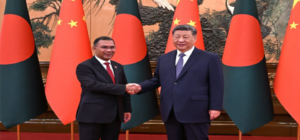
Much has been written recently about Bangladesh’s connectivity with China and Myanmar via a corridor through Mandalay since Prime Minister Tarique Rahman’s visit to China. Reports abound of Bangladesh being supposedly ‘drawn’ towards China. However, the Bangladesh-China-Myanmar Highway project is anything but new. Bangladesh’s possible connectivity with China through Myanmar dates back almost 60 years, to when the United Nations Economic and Social Commission for Asia and the Pacific (UNESCAP) proposed the Asian Highway Network. The route to Mandalay also largely follows the Burma Road, the Allied supply route built during World War II that connected China to the rest of the world.
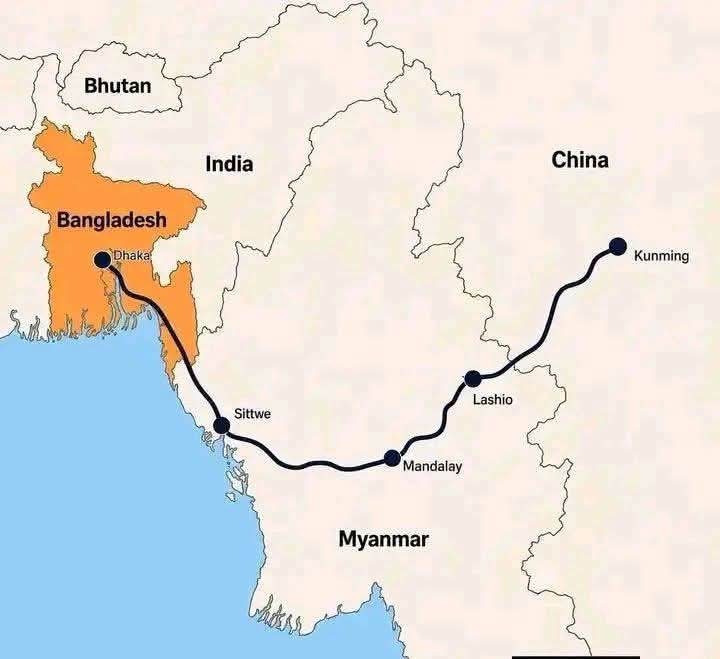
Bangladesh is merely continuing its commitment to improving connectivity rather than jumping on any bandwagon. Bangladesh has already demonstrated its willingness to participate by constructing a modern four-lane highway extending to the Myanmar border. Dhaka knows that connectivity would open the door to more trade, investment, and tourists flowing into the country while helping Bangladesh engage more actively with South Asia and Southeast Asia.
Regrettably, no further development has occurred for years because the counterpart on the Myanmar side has not been established. Internal strife and politics prevented successive governments from developing what could have been Asia’s single biggest transport corridor. Bangladesh has been sitting on its vast infrastructure without use, and the dream of regional economic growth once again lies dormant.
However, now that China has entered the scene in Myanmar in a big way, there might be a chance to resurrect the project. China currently has significant economic and political influence in Myanmar. With huge infrastructure investments pouring in across the board, along with energy and trade deals. Should China convince Myanmar’s leaders to reach an agreement to complete the remaining work on the project, Bangladesh could finally see its dream of a seamless road link to China realized.
The pros and advantages are extensive. Bangladesh would gain direct access to China’s trade markets and manufacturing centers and strengthen commercial relations with Myanmar. Transportation costs on Bangladeshi exports will diminish, investment opportunities will become more readily available on both sides of the border, and Bangladeshi companies will have the opportunity to branch out into logistics, warehousing, and industrial development along the corridor. Tourism among the three countries has the potential to flourish with improved road access.
The highway project will deepen ties between the countries in other ways as well. South Asia is one of the most underconnected regions in the world, despite having the potential to be a powerful economic unit. Transport corridors enable the development of supply chains, provide alternatives when they face bottlenecks, and increase regional cooperation. Additionally, improved connectivity would allow those living in landlocked regions better access to markets they have previously been cut off from.
India is unlikely to be as thrilled about the possibility of such a corridor. New Delhi has for decades viewed the Bay of Bengal and its adjoining northeast frontier as a strategic sphere of influence. Any new overland corridors that involve China raise concerns in India about the growth of Beijing’s economic clout and geopolitical footprint in South Asia. Some Indian commentators see Chinese-backed infrastructure projects gradually turning into strategic footholds as part of China’s Belt and Road Initiative (BRI).
Fair enough from the standpoint of Realpolitik. But let’s not lose sight of what is good economics. Regional integration is not a race where one country’s gain is necessarily another’s loss. Trade and transport corridors can, if planned and operated equitably, produce “win-wins” for Bangladesh, China, India, and Myanmar. South-Southeast Asian connectivity can enhance rather than detract from sub-regional cooperation if pursued openly, respectfully, and economically.
So perhaps it’s time to start looking at the Bangladesh-China-Myanmar road less as a geopolitical wedge and more as something long in the making. Asians once rode the Silk Road; now they could drive it. If the Bangladesh-China-India-Myanmar Economic Corridor (BCIM) Highway is built and China can entice Myanmar to play ball, it could be Asia’s most impactful infrastructure project.