Climate change is rendering Bangladesh’s half-century-old meteorological terminology struggling to keep pace with the ground reality.
When the Bangladesh Meteorological Department (BMD) issued a forecast of “heavy to very heavy” rainfall in its regular bulletin on July 15, the terminology carried a precise technical meaning: rainfall of more than 44 millimetres (mm).

What transpired was a 200-mm deluge.
Under the department’s classification system, which has remained unchanged since the country’s independence, daily rainfall is divided into five categories.
Rainfall between 1 and 10 mm is classified as light, 11 to 22 mm as moderate, 23 to 43 mm as moderately heavy, and 44 to 88 mm as heavy. Any rainfall exceeding 88 millimetres in a day is categorised simply as very heavy.
When 200 millimetres of rain is grouped under the same warning label as 89 mm, the public and policymakers lose the ability to gauge the true level of risk.
A week before the recent devastating landslides in the Chattogram region, the BMD forecast consecutive days of heavy to very heavy rainfall and explicitly warned of landslide risks.
However, because the terminology lacked the urgency conveyed by more modern, impact-based warning systems, the forecast failed to trigger an adequate emergency response from the relevant government agencies.
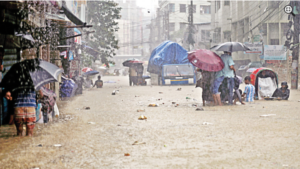
More than 50 people were killed across Chattogram, while Dhaka experienced severe waterlogging and widespread disruption.
By comparison, the India Meteorological Department (IMD) issued a “Red Alert” for Mumbai on July 6, urging residents to avoid non-essential travel.
Such impact-based forecasting, which combines weather predictions with explicit public guidance, has become standard practice in many countries but is still evolving in Bangladesh.
Because the meaning of “heavy” rainfall varies from one climate to another, meteorological agencies around the world regularly revise their classification systems to reflect changing weather patterns.
India’s IMD uses a more detailed rainfall scale. It classifies rainfall of up to 15 mm as light, 16 to 65 mm as moderate, and 66 to 111 mm as heavy.
Rainfall between 115 and 204 mm is classified as very heavy, while rainfall of 205 mm or more is categorised as extremely heavy.
China follows a similarly expanded classification, defining rainfall between 100 and 249 mm as heavy torrential rain and reserving the category of extremely torrential rain for rainfall exceeding 250 mm.
Several Western countries also assess rainfall intensity on an hourly rather than daily basis.
In the UK, 8 mm of rainfall in an hour is considered very heavy, while the US classifies rainfall of 7.6 mm per hour as heavy.
Recognising the shortcomings of the current system, the BMD has begun reviewing its rainfall classifications.
Meteorologists said internal discussions are under way to substantially revise the thresholds.
One proposal under consideration would raise the lower limit for very heavy rainfall from 89 mm to 150 mm, requiring a broader recalibration of the entire rainfall classification system.
The BMD has also introduced several technological improvements.
Its newly launched website features a Common Alert Protocol-based, colour-coded risk matrix, replacing the previous platform. It also provides upazila-specific forecasts and sector-specific warnings for aviation, agriculture and maritime operations.
According to the BMD, the upgraded forecasting system is now capable of predicting rainfall and heatwaves five to seven days in advance.
Coordinated action by government agencies based on the Met Office’s early warnings could significantly reduce disaster-related losses, said Momenul Islam, acting director of the BMD.
The department’s forecasting capability has improved substantially in recent years, and it can now provide rainfall forecasts five days in advance with about 95 percent accuracy.
Referring to the recent spell of torrential rain, he said the Met Office had been warning of heavy rainfall since July 4 and issued a landslide warning on July 5.
“We saw landslides in Cox’s Bazar on July 6. We warned about very heavy rainfall and also about landslides.”
Regarding the current definitions of heavy and very heavy rainfall, Momenul said the department is considering revising the rainfall thresholds.
“But it needs discussion with the stakeholders before implementation to ensure proper communication,” he said.
The bigger challenge, however, lies not in forecasting but in translating forecasts into coordinated action across government agencies.
Bangladesh has become a global leader in disaster risk management, reducing cyclone-related deaths from hundreds of thousands to single digits over the past five decades.
That success, experts say, has been possible because cyclone forecasts issued by the BMD are followed by swift, coordinated and well-communicated government action.
Bangladesh already benefits from satellite technology and support from its international partners, said Rashed Chowdhury, an eminent climatologist.
However, the country must invest further in strengthening its forecasting capacity by expanding the observation network, upgrading computing infrastructure, improving data assimilation, enhancing high-resolution weather models, strengthening impact-based forecasting, training forecasters, and ensuring timely communication of warnings to communities and policymakers.
Operational forecasting currently focuses primarily on the next three to seven days.
While this remains essential, Bangladesh also needs to strengthen seasonal and interannual forecasting through regular, year-round monitoring of the El Niño-Southern Oscillation (ENSO) and other large-scale climate drivers on at least a monthly basis, rather than only when hazards appear imminent, he said.
Such climate monitoring would provide the foundation for early preparedness in agriculture, water resources, public health and disaster risk reduction.
“Currently, there is limited institutional initiative and investment in this area.”
Source: https://www.thedailystar.net/news/environment/climate-crisis/news/met-offices-old-ways-mask-true-extent-rainfall-4231271