South Asia Journal
India is proud of being a democracy based on the constitution, and this is due to the country’s diversity in terms of religion, languages, tribes, and cultures. Since India attained independence, the constitutional framework has always distinguished itself with respect to the rest of the world through the embrace of constitutional secularism, which meant that the nation was a democratic polity in which different religions did not have privileged status and could not exercise undue influence over the running of affairs of the state. Today, with increasing tensions surrounding Muslim minority rights in India, a question arises regarding whether constitutional secularism is able to survive whenever political culture diverges from the core principles of secular democracy.
Recent restrictions and discouragement of Muslim religious activities during the Eid al-Adha in some parts of India, particularly West Bengal, have raised serious concerns among Indian Muslims as the observances of the festivity continue to be surrounded by administrative restrictions, intense surveillance, and increased politicization. Although these issues could appear trivial, they represent a much more serious challenge that touches the very essence of India as a modern democratic republic. The issue here is not only about cattle sacrifice or rituals, but rather about constitutional rights and the future of the Indian democracy itself.
The Idea of Constitutional Secularism in India
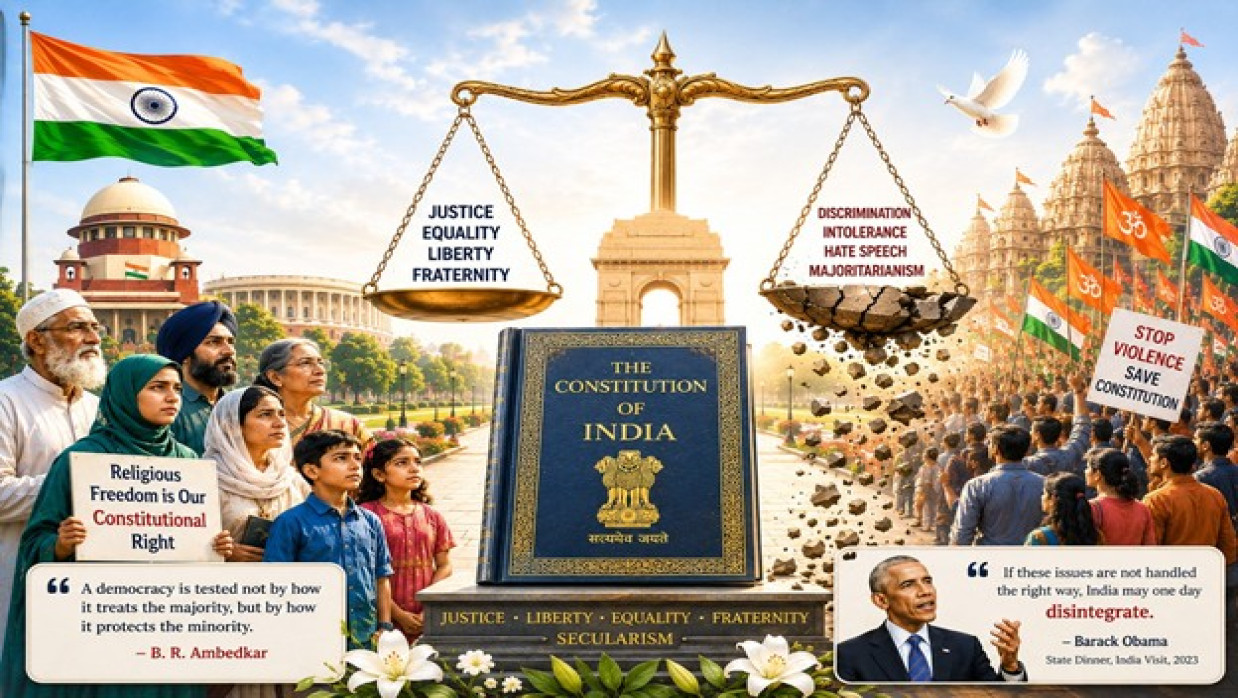
According to Articles 14, 15, 25, and 26 of the Indian Constitution, every individual residing in India should be equal before the law and enjoy freedom of worship without fear or intimidation, irrespective of religion. Thus, the founding fathers of the Indian nation were clear in their determination not to establish religious dominance but to promote state neutrality on the issue.
In addition, Indian secularism is distinct from irreligiosity or hatred of religion as a general concept. What it means is that India is a constitutional republic with diverse religions, in which the government neither promotes nor persecutes any religion or religious practice.
In other words, Indian secularism combines state neutrality and equality of different religions before the constitution.
The idea of constitutional secularism in India originated in the history of the partition of India and the realization that the nation needed to protect its pluralism to survive. This idea was embraced by Indian politicians such as Jawaharlal Nehru, B. R. Ambedkar, and Mahatma Gandhi, who understood that democracy in the nation could work effectively only if minority groups felt confident regarding the fairness of the Indian state.
Despite India experiencing a number of conflicts related to religion, the constitutional framework has largely maintained the necessary balance over the past decades.
However, since the advent of the era of political religious symbolism, constitutional promises of secularism are now being increasingly challenged.
Religious Restrictions: Symbolic Politics of Cow Protection and Nationalism
Eid-ul-Adha is a religious festival for Muslims worldwide that involves a ritual of sacrifice, called Qurbani, performed to celebrate the mercy of God and express gratitude to Him through selfless acts of charity and generosity. This festival, however, continues to be surrounded by numerous controversies in India owing to the practice of cattle sacrifice.
With the advent of nationalism and politicization of the issue of cow protection in the nation, the practice of cattle sacrifice by Indian Muslims became a target of strong condemnation from majoritarian nationalists and politicians who sought to protect the Hindu religion from any form of abuse.
Today, restrictions on this religious act continue to be imposed in various states, particularly West Bengal, in the name of public safety and welfare, religious sensitivity, or protection of cows.
While these restrictions are justified in legal terms, they clearly reflect a trend in which minority rights continue to suffer under the pressure of majoritarian discourses and religious nationalism.
Moreover, as the issue has become politicized, Indian Muslims are likely to lose their right to exercise their constitutional freedom in performing religious acts without any interference from the government or the administration.
Thus, constitutional secularism becomes a victim of majoritarianism.
Rule by Law vs. Rule by Majoritarian Sentiment
Constitutional secularism in India is currently threatened by majoritarian discourses of political leaders, politicians, media systems, and social media, which tend to view minority groups as enemies of the nation or demographic threats to the unity of India.
What this suggests is that the mere existence of constitutional rights will not help minorities to secure their democratic freedoms and liberties if political discourses start viewing Muslims as foreigners who do not belong to the nation anymore. Under such conditions, secularism loses its meaning as the Indian nation begins to treat Muslims as outsiders rather than full-fledged Indian citizens who happen to have a different religion.
Thus, constitutional secularism fails when rule by law is replaced with rule by majoritarian sentiment.
Constitutional Rights and Political Culture: Two Faces of Indian Democracy
One of the most prevalent myths in modern democracies is that constitutions alone are enough to preserve freedom and constitutional rights. However, experience shows that constitutions live only if they have the support of political elites, political institutions, media systems, and citizens. Constitutional democracy is usually undermined when political culture begins to discriminate against particular communities.
It happens either through demonizing them, instrumentalizing national narratives, or transforming electoral majority into a tool to dominate other people’s culture. As a result, minority groups in the nation begin to feel unsafe and unprotected as they do not want to risk their constitutional freedoms.
Thus, constitutional secularism in India becomes vulnerable whenever politicians gain electoral advantages through polarization, religious propaganda, and demonization of religious minorities.
The Case of West Bengal: Political Polarization of India’s Pluralistic Region
While the case of West Bengal represents an important episode in the current crisis of constitutional secularism in India, it also demonstrates the broader tendency of Indian politics to polarize the nation through majoritarian politics.
Traditionally, West Bengal has been recognized as one of the most pluralistic areas of India owing to the immense diversity it offers. At the same time, the area has not remained immune to the trends prevalent in India, especially the polarization of politics along majoritarian lines.
Thus, the situation in West Bengal has worsened over time, as increased political competition has made religious issues a popular topic in electoral campaigns and political discourse.
As a consequence, the Indian Constitution becomes vulnerable to threats from politicians,, and Indian society loses its plurality.
International Concerns Over Future of Indian Secular Democracy
The crisis of constitutional secularism in India has attracted serious attention from democratic countries worldwide, which view India as an important player in the global arena of geopolitical and economic interests.
In fact, despite the enthusiastic response from the Americans towards the visit of India to the United States, most of the talks revolve around the present scenario in India in terms of the rights of the minorities and the religious conflicts. In particular, the former president of the United States, Barack Obama, has expressed his views concerning the concept of constitutional secularism in India.
Obama argued that if India failed to solve the issue of Muslim minorities and religious tension, it would be doomed to face further instability and fragmentation in the future.
Thus, Obama stressed the importance of preserving constitutional democracy based on the principles of equality, respect, and secularism.
Significance of Obama’s Observation in the Larger Historical Framework of Democracy
The significance of Obama’s observation is not limited to its diplomatic value, because what he said is based on a well-known democratic principle: no nation can preserve stability and unity if some of its segments perceive themselves as disadvantaged or politically insecure. The example of Israel and Palestine serves as a good illustration of this phenomenon, as Israel and Palestine are constantly experiencing internal conflicts.
However, India is more concerned with internal unity, as its population comprises diverse ethnic, religious, cultural, and linguistic groups.
Thus, the role of Obama’s warning was to remind India’s politicians that the unity of the nation will not last long if they continue treating some groups in a discriminatory manner.
Secularism and Minority Rights in a Civilizational Perspective
From a civilizational perspective, India is one of the most successful nations since it manages to combine its cultural diversity into an integral national identity. Indeed, the subcontinent is home to millions of people practicing Islam, Sikhism, Hinduism, Christianity, Buddhism, etc. Moreover, some of its populations can trace their history back hundreds of years.
Under such circumstances, constitutional secularism becomes even more important for preserving unity and stability.
If India starts perceiving Muslims as a religious or even racial minority that threatens its unity and security, it will eventually break down internally.
Global Warnings Regarding the Constitutional Secularism of India
India is not an isolated case of a democracy experiencing difficulties with maintaining its constitutional secularism, since the phenomenon of majoritarian politics is spreading rapidly around the world. Populist movements become active in Europe, Asia, America, etc., trying to rebrand the notion of a nation as an ethnic community based on homogeneity of religion and culture.
Thus, constitutional institutions face challenges in maintaining democratic principles due to pressure from nationalistic political forces that view dissent as opposition to the nation itself.
Nevertheless, the Indian case is unique due to its cultural plurality, which gives it a distinct historical significance.
Therefore, a threat to its constitutional secularism has far-reaching consequences for the world as a whole.
Reclaiming Constitutional Morality
Ultimately, the future of Indian democracy depends not merely on courts or constitutional clauses, but on whether political leadership and civil society are willing to reclaim constitutional morality as a living democratic ethic.
Constitutional morality is not just about adherence to law but also includes restraint among politicians, protection of the weaker sections, press behavior, and leadership from political figures who transcend electioneering.
India’s Founding Fathers knew a fundamental truth—that pluralism is possible only through inclusion and equality, not fear, compulsion, or cultural dominance.
The true test of democracy is not how it treats its majority, but how confidently minorities feel protected within the national community.
Secularism, when made selective, jeopardizes democracy itself.
This, in fact, is why the mounting conflicts related to minorities, religion, and politics in India can be seen as not just a set of political crises but as an indication of the greater struggle taking place over whether India will continue being a constitutional republic that embraces plurality or whether it will become a democracy that only nominally upholds it.
The future of India may ultimately depend on which vision prevails.
“Democracy is not merely a form of government; it is primarily a mode of associated living, of conjoint communicated experience.” — B. R. Ambedkar.

Dr. Serajul I. Bhuiyan
Dr. Serajul I. Bhuiyan is a Professor and former Chair of the Department of Journalism and Mass Communications at Savannah State University.