South Asia Journal
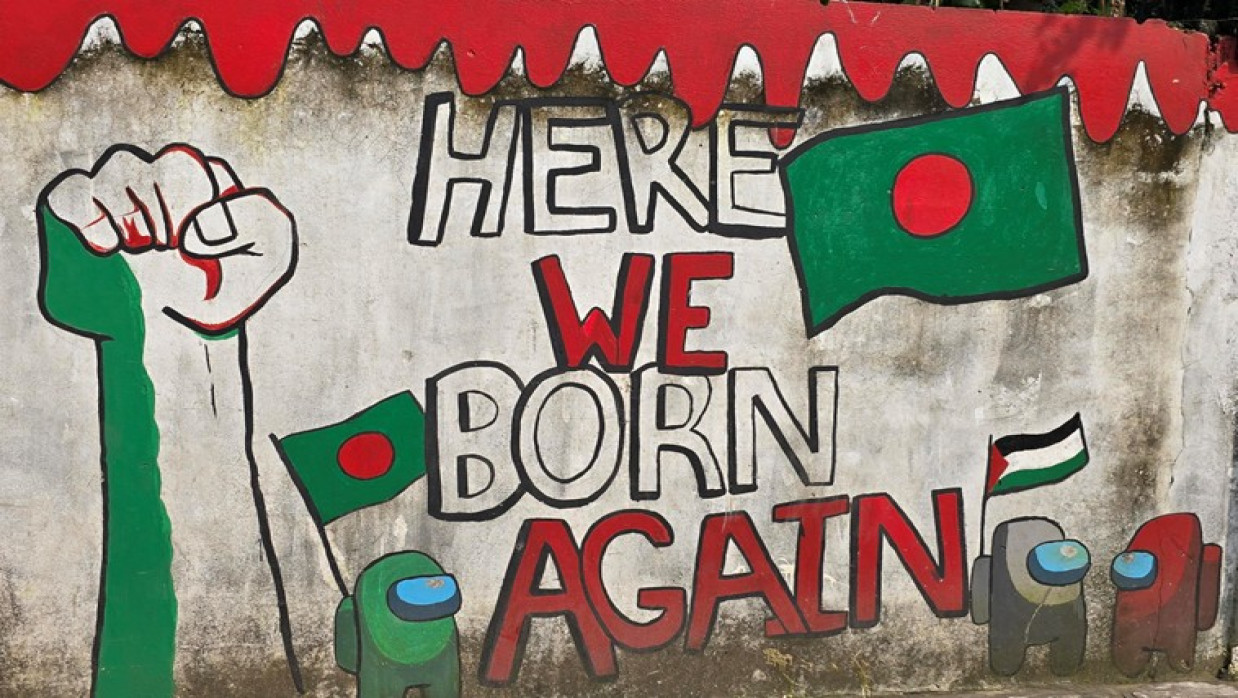
A graffiti on a wall in Dhaka, drawn by the July 2024 Gen Z. Southasia Journal archives
The mass uprising of July 2024 produced one of the sharpest debates that Bangladesh has witnessed since independence. While the initial reaction of many was to look for parallels to the Liberation War of 1971 to understand what had happened in July, a section of voices now contends that drawing parallels between the two phenomena does not do justice to July. They ask us to see July as something different altogether. July made us question everything we thought we knew about the Bangladeshi state: What does it mean to be sovereign? How do religion and politics intersect? Did we really achieve what we set out to do in ’71? What does justice truly look like for the people of Bangladesh?
Implied in that line of questioning is whether the Bangladesh we have inherited since 1971, the Bangladesh that was created in ’71, was what we truly wanted in the first place.
The Unfinished Promise of Independence
Bangladesh got a new set of rulers, but didn’t change how it was ruled. Institutions, mentality, and power remained centralized. Bangladesh inherited the system from the British through Pakistan and from Pakistan through independence.
Critics argue that the state that emerged after 1971 replicated several of its vilified traits. Decision-making remained centralized; power remained concentrated among the political elite; the bureaucracy remained powerful; and coercion became an intermittent tool of every regime. Liberation was thus only partially fulfilled. Independence gave Bangladesh freedom from Pakistan, but many say it failed to give political power to the people.
In this way, July 2024 was not simply against a government; it was against the political order that had been ruling for decades.
Why 2024 Cannot Be Reduced to 1971
When talking about the Liberation War of 1971, people often regard it as sacred and hold it dear to their hearts. It was fought over oppression by the Pakistan Army, discrimination in politics, and deprivation of fundamental rights. Many Bangladeshis who took part in the July movement believe otherwise.
The Liberation War was fought for independence from an external political center, namely West Pakistan, whereas the July 20 War was fought over internal political structures within Bangladesh.
Trying to conflate July 2024 with the Liberation War of 1971 is, therefore, unacceptable to many who participated in the movement. Some have claimed that such comparisons hurt the reality of what happened in July and hinder Bangladesh from facing the problems it faced after 1971 objectively.
Abu Saeed and the Symbolism of Sacrifice
The image of Abu Saeed’s face has become the emblem of July 2024. Hours after teenagers faced police outside their homes, images of the boy standing defiantly in front of the police while holding guns and seemingly doing nothing more than fight the accusations spread like wildfire on social media.
This was different. Journalists and pundits were characterizing Abu Saeed’s death differently. Rather than an innocent victim caught in the chaos of protests, many cast Abu Saeed’s death as noble. His willingness to stand up to the establishment and die showed a principled stand against oppression.
The death transcended political intrigue. Abu Saeed’s death had spiritual implications. It asked questions about courage and mortality. What does it mean to be human? In Abu Saeed, we lost someone who demonstrated to us that there are things greater than life itself. And that you can stand up to power with more than guns.
In death, Abu Saeed became a martyr for the cause of all Generation Z.
Fear, Power, and the Modern State
Governments typically rule through threats and inducements. Law, police, jails, jobs, party loyalty… These tools are what keep governments on top.
July said they didn’t work anymore.
If people are not moved by fear and self-interest, it becomes very difficult to control them using these methods.
That is why self-immolation is such a potent political weapon. It exposes the false sense of power that our governments believe they have.
Politics is merely the consent of the governed. If enough people refuse to grant that consent, the state loses its power.
For many of those who protested, their readiness to face hardship came down to faith, values, and kinship. Politics became a war for the soul.
Religion, Politics, and Public Life
Finally, there’s also been discussion about religion and politics. Ever since Bangladesh became independent, there have been competing narratives of nationalism. Some have argued for secular nationalism. Others have spoken of Islam’s important role in society and culture.
The movement revived these debates. We saw increased public prayers, Islamic slogans and historical narratives. Supporters did not view this as anti-democratic. They saw it as being more truthful to society.
Under this logic, forcing religion into the private sphere doesn’t take into account the lived reality of Muslims in Bengal. Faith has been a tool for social justice. It’s been used to fight against colonialism and to organize communities across Bengal.
I think Bangladesh’s future struggle will be to accommodate these two ideas. How can they allow for religious freedom whilst maintaining pluralism and democratic rights?
Historical Roots of Resistance
The demands made pre- and post-July were not invented overnight. They were not new to Bengal. Bengal had a history of demand for self-rule. The Bengal Sultanate was Bengal’s first major assertion of its political uniqueness. This was followed by movements against Mughal centralization, during which the Baro-Bhuiyans effectively ruled vast swaths of Bengal independently. The Faraizi movement in nineteenth-century Bangladesh melded Islamic reformism with peasants’ demands for economic independence. Movements against colonial rule, centralized hegemony, and autonomy defined much of twentieth-century Bengal, too.
History reminds us of these patterns. Time and again, we’ve struggled against centralized power. Time and again, we’ve asked for greater self-governance of our local affairs. Time and again, we’ve risen up for economic justice. Time and again, we’ve tried to hold on to our cultural and religious identity.
The July movement drew on these past struggles and sought to contextualize our problems within a longer history.
The Question of Autonomy
An interesting aspect of the article is its comparison between Muhammad Ali Jinnah’s Lahore Resolution of 1940 and Sheikh Mujibur Rahman’s Six-Point Movement of 1966. Both sought meaningful autonomy within a larger political framework. The Lahore Resolution demanded that constituent units in Muslim-majority provinces shall have “sovereign” or “autonomous” status within a weak constitutional framework. Likewise, the Six-Point movement demanded a “real federal” constitution for Pakistan with significant autonomy for the provinces. It sought to restrict the jurisdiction of the central government to defense and foreign policy only. While the Lahore Resolution led to Pakistan’s independence, the rejection of the Six Points resulted in political turmoil and the creation of Bangladesh in 1971.
Neither effort worked as planned. The Pakistan idea turned into centralized domination that eventually drove away those in East Pakistan. The Bangladesh project is also accused of becoming highly centralized after independence.
If this is true, then we could argue that what people really wanted was autonomy and a voice in their government. Independence or federation were just means to get there. The July movement throws all of these issues back into question.
Identity, Memory, and Social Solidarity
It also raised questions about issues of identity and belonging. Many writers invoked fourteenth-century historian Ibn Khaldun and the importance of social solidarity, or Asabiyya. Civilizations flourish when there’s a sense of working towards common goals. Asabiyya refers to social cohesion, group solidarity, collective identity, and the willingness of people to work together for a common purpose. It is the bond that unites members of a tribe, community, nation, or civilization.
They rot when people stop caring about a common set of values. July’s uprising showed there’s a yearning among many young Bangladeshis to revive their connection with the past: with history, culture, faith, and common dreams.
Support it or hate it, I think it showed Bangladeshis are looking for something beyond traditional party politics.
Toward a New National Conversation
So what does July 2024 matter in the long run? I would argue that its significance goes beyond the specific political issues at stake. In July 2024, a national dialogue process about Bangladesh’s past, present, and future began. It called into question received wisdom about issues that have long defined society’s approach to governance, statehood, identity, and citizenship.
July exposed grievances over the concentration of power, fear of democratic backsliding, and demand for a new inclusive political order. It also showed that principles of faith and history still matter.
Will July 2024 go down in history as a moment of radical change? Only time will tell. But for now, we can say that it has changed the conversation about Bangladesh and what it means to be Bangladeshi. It forced us to confront the question of whether we are truly independent. Or if we still have work to do to dismantle the structures, politics, and popular mentality that came with this “gift” of independence.
In that regard, perhaps we should look at July 2024 not just as a movement, but as the beginning of a process of national self-reflection.