South Asia Journal
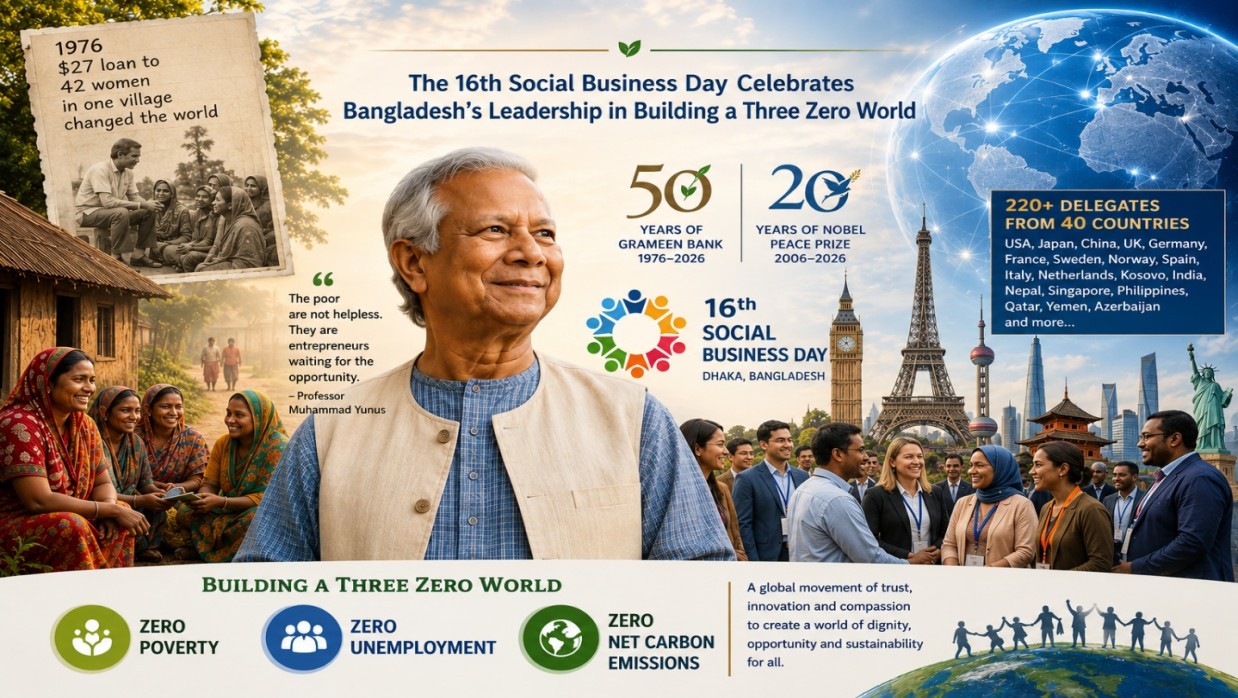
From a humble village initiative in Bangladesh to a worldwide movement for inclusive prosperity, the 16th Social Business Day celebrates the enduring legacy of Professor Muhammad Yunus and the global commitment to building a future founded on the Three Zeros—Zero Poverty, Zero Unemployment, and Zero Net Carbon Emissions.
For a few inspiring days, Dhaka once again stood at the center of a global conversation about creating a more just and sustainable world. More than 220 delegates from different countries gathered in Bangladesh’s capital for the 16th Social Business Day, reaffirming the country’s remarkable role in shaping one of the most influential development philosophies of the modern era.
The event was much more than an international conference. It was a celebration of an idea that began almost five decades ago in a small Bangladeshi village and has since grown into a worldwide movement. What started in 1976 with a modest loan of US$27 to 42 impoverished women has transformed the way governments, development organizations, universities, entrepreneurs, and policymakers think about poverty, business, and human dignity.
This year’s conference has had a wide array of international delegates. They came from the USA, Japan, China, the UK, Germany, France, Sweden, Norway, Spain, Italy, the Netherlands, Kosovo, India, Nepal, Singapore, the Philippines, Qatar, Yemen, Azerbaijan, and many other nations worldwide. They were made up of government officials, university representatives, banks and financial institutions, corporations, NGOs, and youth, who all shared a common vision of the need for new ideas to address today’s global problems.
It is because people around the world have realized that the existing economic system is not enough to address issues such as poverty, inequality, unemployment, environmental pollution, and global warming. There is an increasing number of countries seeking fresh thinking, and one can see an entrepreneurial approach combined with social responsibility.
The 16th Social Business Day has special importance as it fell on the occasion of two important events marking anniversaries – 50 years of Grameen Bank and 20 years of the Nobel Peace Prize given jointly to Professor Muhammad Yunus and Grameen Bank. This was a chance to appreciate remarkable accomplishments and to consider the movement’s future development.
A Distinguished Leadership Reflecting Bangladesh’s Global Vision
The inauguration ceremony featured some of the most important figures in the world’s social business community, thereby highlighting Bangladesh’s continued leading role in fostering inclusive growth.
The main speech was delivered by Professor Muhammad Yunus, the Nobel Peace Prize laureate, whose innovative microcredit concept transformed the global understanding of poverty eradication and financial inclusion. By proving that poor people are both creditworthy and entrepreneurial, he revolutionized traditional concepts in banking and development economics. Moreover, his later idea of social business went one step further in terms of philosophy, according to which a company should be set up to address pressing issues rather than to make a profit.
Joining him at the inaugural session was Mr. Ashraful Hasan, Chairman of Grameen Trust, whose leadership has helped extend the Grameen approach far beyond Bangladesh. Through partnerships in dozens of countries, Grameen Trust has played a significant role in expanding financial inclusion, encouraging entrepreneurship, and empowering marginalized communities worldwide.
Another eminent speaker, Dr. Abdul Hannan Chowdhury, Chairman of Grameen Bank and Vice Chancellor of North South University, stressed the growing need for universities to groom their students to become socially responsible leaders in the future. He stated that universities needed to go beyond the conventional aim of preparing individuals for employment and rather focus on fostering innovation that helps solve society’s major issues.
Ms. Lamiya Morshed, Executive Director of Yunus Center and Grameen Healthcare Trust, moderated the first session of the conference very effectively. In her opening speech, she traced the history of the social business movement from its initial stages in rural areas of Bangladesh to its recognition worldwide as a model for sustainable development. On the other hand, she exhorted the delegates to think of the conference not only as a forum for sharing their experiences but also as an occasion to forge international relations to promote social innovation.
Collectively, the presenters delivered an emphatic message that social businesses have come a long way since being a development idea originating in Bangladesh. Instead, it is now an international movement founded on cooperation, innovation, and a dedication to improving people’s lives through entrepreneurship.
Bangladesh’s Gift to the World
No innovation from the Global South has had a more profound effect on the world than the Grameen phenomenon. The success story of the phenomenon is one of the best illustrations of how an innovative concept, inspired by compassion and reality, can change the world’s perception.
When Professor Muhammad Yunus began lending small amounts to impoverished women in Jobra village in 1976, many thought his initiative was impractical. Traditional financial institutions believed that the poor were unbankable because they lacked collateral, sufficient financial acumen, or reliability to be eligible for borrowing.
The Grameen model directly contradicted those beliefs.
Instead of focusing on what poor people lacked, Grameen focused on what they had: dedication, skills, creativity, and a strong desire to better themselves. Collateral was replaced by trust. Human dignity became the basis of financial inclusion.
The results exceeded even the expectations of its earliest supporters.
Over time, microcredit evolved into one of the world’s most widely replicated development innovations, reaching communities across Asia, Africa, Latin America, Europe, and North America. Yet the movement did not stop there. It gradually developed into the broader concept of social business—an approach in which businesses are established primarily to solve social problems while generating enough revenue to sustain their operations without depending indefinitely on charity or donations.
According to this framework, success is determined not only by monetary gain but also by the betterment of people’s lives, stronger communities, increased access to educational and health services, more employment opportunities, a sustainable environment, and the overall resilience of society.
At a time when many societies continue to struggle with widening inequality, climate change, unemployment, and social fragmentation, the philosophy of social business offers an alternative vision—one that places human well-being alongside economic sustainability rather than treating the two as competing goals.
The Three Zeros: A Blueprint for a Better Civilization
The vision around which the 2018 Social Business Day revolved is an inspiring one that has been increasingly linked with Professor Muhammad Yunus—namely, the notion of the Three Zeros:
- Zero Poverty
• Zero Unemployment
• Zero Net Carbon Emissions
Though such targets might seem unrealistic and ambitious at first glance, the conference showed that there is more to these phrases than empty talk. Taken together, they constitute a basis for reconsidering approaches to organizing an economy and measuring development.
One of the recurring themes in the discussion was the interconnectedness of the problems currently facing our globe. Poverty can no longer be fought in isolation from environmental damage. The impacts of climate change make poor people even more economically vulnerable. Continued unemployment leads to inequality and hinders future opportunities. Addressing only one problem and ignoring the rest will only make it even more difficult to deal with in the long run.
The Three Zeros philosophy calls for a more integrated approach—one that recognizes the links between economic opportunity, environmental stewardship, and social justice. Instead of viewing these priorities as competing interests, the framework argues that they should reinforce one another.
This vision is built on an even more fundamental reassessment of the purpose of enterprise. In addition to generating profits, enterprises can use their power to address social and environmental issues while remaining profitable. This is quite a paradigm shift from the traditional economics approach and promotes the idea that the state, business, education, and civil society should be aligned in achieving certain goals rather than working in parallel worlds.
The Three Zeros offer a way forward in this transformation, which, according to numerous speakers at the conference, would involve fresh ideas and collaboration among leaders to challenge the old paradigms of economic growth.
A Truly Global Movement
One of the most remarkable features of the 16th Social Business Day was the extraordinary diversity of its participants.
What began as an initiative rooted in rural Bangladesh has grown into a worldwide movement that now connects people from vastly different cultures, professions, and sectors. Walking through the conference halls, one encountered government officials exchanging ideas with university researchers, entrepreneurs collaborating with nonprofit leaders, students engaging with policymakers, and financial experts discussing solutions alongside community organizers.
The breadth of representation demonstrated how widely the philosophy of social business has spread over the past several decades.
Participants represented universities, governments, multinational corporations, financial institutions, research organizations, nongovernmental organizations, youth networks, and development agencies from every region of the world. Although their professional backgrounds differed, they shared a common belief: that entrepreneurship can serve society as well as markets. The conference program reflected this diversity.
While plenary discussions focused on the future of social businesses amid growing global uncertainty, special sessions covered topics including health, education, financial inclusion, climate resilience, digital technologies, female empowerment, and youth entrepreneurship. Interactive workshops encouraged participants to share practical experiences, find innovative solutions, and create partnerships going beyond the conference.
Instead of highlighting only success stories, this conference became an international forum for exchanging ideas. They could openly discuss their problems, share experiences, and learn from mistakes as they tried to apply social business models across different countries.
It has shown the development achieved by the movement in an international forum. The social business is no longer regarded as something unique to Bangladesh, but has evolved into a global ecosystem, bound together by the common purpose of addressing societal issues sustainably through entrepreneurship.
Education for Social Transformation
Education became an integral part of this year’s debates as awareness increases that universities’ role in shaping the next generation of changemakers is pivotal.
One of the most important topics discussed at the conference was the progress at Grameen University, an institution designed to transform the traditional role of higher education.
Traditionally, universities were meant to train students for the labor market. However, according to the founders of Grameen University, there should be more from higher education institutions than merely training job-seekers. Universities must also produce job creators, innovators, and social entrepreneurs.
This philosophy represents a fundamental shift in educational thinking.
Students are encouraged not merely to master academic knowledge but also to develop the creativity, ethical awareness, and entrepreneurial mindset needed to improve their communities. Innovation is viewed not simply as a pathway to commercial success but as a means of addressing poverty, inequality, healthcare, environmental sustainability, and other pressing public concerns.
In such a setting, Grameen University is more than just another university because it represents an entirely new approach to education—one that strives to unite academic success with social responsibility.
In that context, Grameen University represents more than another higher education institution. It embodies a new educational philosophy—one that seeks to align academic excellence with social responsibility and sustainable development.
Youth at the Center of Global Change
Another defining feature of the conference was its strong emphasis on young people.
Throughout the sessions, speakers repeatedly emphasized that the future of the social business movement depends on the creativity, energy, and idealism of the next generation. Young people are not viewed merely as future beneficiaries of social change; they are expected to become its architects.
That vision is already taking shape through the expansion of Yunus Social Business Centers at universities around the world and the rapid growth of thousands of 3ZERO Clubs, where students develop projects to address local social and environmental challenges.
Such a shift in outlook forms the essence of the social entrepreneurship mindset.
Several instances of social innovations in the form of projects executed by young people from diverse fields like renewable energy, healthcare, education, digital inclusion, waste disposal, agriculture, and banking were presented at the conference. The projects revealed that social innovations could originate from simple concepts backed by sheer perseverance.
By investing in young leaders today, the movement aims to build a future in which entrepreneurship becomes a powerful force for creating more inclusive, equitable, and sustainable societies.
The discussions throughout these sessions conveyed a consistent message: lasting change cannot be achieved by governments, businesses, or civil society acting alone. It requires collaboration across generations, institutions, and national boundaries. Universities, young entrepreneurs, researchers, policymakers, and community leaders all have essential roles to play in shaping an economy that serves humanity rather than the other way around.
Bangladesh’s Expanding Soft Power
In addition to the inspiring dialogues and exchange of ideas, the 16th Social Business Day underscored another significant fact – that Bangladesh has become a major player on the global stage, influencing the world not only with its economic success but also as a source of inspiration through its intellectual contributions.
It is common for most developing countries to gain international recognition by succeeding in trade or industry, or by receiving foreign aid. However, Bangladesh has shown that it can have an impact on the world through its ideas and its changing development discourse.
This was a great demonstration of the power of such increasing influence.
With scholars, policymakers, entrepreneurs, investors, and social innovators from all corners of the world, Bangladesh demonstrated its convening power by becoming a place where international collaboration can take place. The conference demonstrated not only that Bangladesh had something to say but also that it could be a place where we discuss some of the most urgent issues facing humanity.
This form of influence often described as soft power is built not on economic or military strength but on credibility, innovation, and the ability to inspire others. Bangladesh’s leadership in social business has given the country a distinctive voice in international discussions on sustainable development, financial inclusion, ethical entrepreneurship, and poverty reduction.
As the search for innovative methods to help meet the UN Sustainable Development Goals (SDGs) continues, Bangladesh has much to offer in terms of experience. These go beyond policy suggestions to actual models developed and adopted in countries around the world.
The international interest evident throughout Social Business Day suggests that Bangladesh’s role in this global conversation is likely to grow even stronger in the years ahead.
From Celebration to Commitment
Although the conference celebrated remarkable achievements, its central message looked firmly toward the future.
Throughout the sessions, participants emphasized that Social Business Day should never be viewed simply as an annual gathering or ceremonial event. Its true significance lies in its ability to inspire action, encourage collaboration, and generate practical solutions to real-world problems.
The problems mankind faces today are enormous. The existence of poverty keeps depriving people of their right to a decent life. Economic and social inequality continues to fuel instability in many regions around the globe. Climate change threatens people’s livelihoods, food security, and even their health, while technology is revolutionizing the labor market at an unprecedented rate.
No single body can address all these problems alone. Governments have no chance to cope with them in isolation from business, universities, financial bodies, nonprofit organizations, scientists, and individuals themselves. Business itself cannot work towards sustainable prosperity without taking into account its own social and environmental responsibility.
One of the greatest lessons from this conference was that entrepreneurship can be the tool of transformation. Business can provide opportunities, restore people’s dignity, help build up communities, and provide economic resilience if it is done for a purpose, not just to make a profit. These ideas of mutual responsibility run through the entire conference. The participants not only received new ideas but also found the courage to make them a reality in their own countries.
A Vision That Continues to Inspire
Nearly fifty years have passed since Professor Muhammad Yunus extended a small loan to 42 women in the village of Jobra—a simple act that challenged conventional wisdom and demonstrated the transformative power of trust. Few could have imagined that such a modest experiment would evolve into a movement influencing development policy, higher education, entrepreneurship, finance, and public discourse worldwide. Yet that is precisely what has happened.
These days, the ideas first proven in rural Bangladesh remain a source of inspiration for governments, universities, companies, international organizations, and millions of people who think that economic systems have to be there for people, not vice versa. At the 16th Social Business Day, it was once again shown that social business is no longer a development approach or business philosophy. Now, it is a global movement encouraging societies to reconsider their approaches to the relationship among markets, morality, and human life.
The strength of this idea lies in a straightforward yet powerful belief: that companies can be economically sustainable while remaining strongly dedicated to addressing social and environmental issues. Profit and purpose need not clash. If combined properly, they will complement each other and provide sustainable solutions for the communities and the next generation.
With delegates leaving Dhaka and returning to their respective nations, it was not just a question of the conference proceedings and policies. They were also carrying the hope that the world’s greatest issues could be tackled through innovation, compassion, collaboration, and responsible enterprise.
It would seem to be the most lasting contribution of the Social Business Day.
It shows us that revolutionary change is not necessarily driven by large amounts of money or state-level initiatives. Instead, it may be sparked by a simple thought, bold enough to question existing practices and focus on human dignity as the most important factor in economic development.
Almost fifty years since a small loan brought about a huge difference in the lives of forty-two women in a village in Bangladesh, this idea still resonates worldwide. It is a testament to the fact that change can start from small beginnings, but with vision and persistence, can evolve into a revolution.
As Dr. Muhammad Yunus rightly says, “Poverty is not caused by poor people. Poverty is caused by the system we have built up, and that system can be changed.” This is what makes the true essence of the movement of social business live on – humanity has the capacity and the responsibility to create an economy that serves not just prosperity but dignity and hope for all.

Dr. Serajul I. Bhuiyan
Dr. Serajul I. Bhuiyan is a Professor and former Chair of the Department of Journalism and Mass Communications at Savannah State University.