by Ghulam Suhrawardi
The oceans and seas have called many adventurers, explorers, and poets throughout the ages. For most people, watching a vessel venture out towards the horizon symbolizes freedom, opportunity, and adventure. However, for those who make a career at sea, call it what you may, but it’s much more than that. It’s a profession that requires sacrifice, patience, and time away from friends and family.
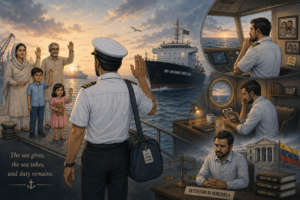
Picture the scene. A sailor kisses his family goodbye before another contract or voyage. It’s a scene every seafarer has experienced time and time again, whether at an airport, a gate, or a gangway. He watches as they depart back to dry land and into his loved one’s arms. He’s making a living at sea, like thousands of other Bangladeshi seamen serving on ships worldwide, but for him, it’s become his life.
Missing birthdays, national holidays, possibly New Year’s, and family gatherings are just some of the things they have to sacrifice as their job dictates they are away from home for months at a time, away from their loved ones: wives, children, parents.
But aside from the personal sacrifices, there’s another harsh reality that few seafarers truly consider when they first embark on their maritime journey: navigating the unfamiliar legal, political, and judicial systems of foreign countries. Captain Mahbubur Rahman, Master of MV Meghna Prestige, has a story that is all too familiar to seafarers around the globe.
Captain Rahman has been held captive in Venezuela since an accidental ground collision. The ship itself was released to return to the world of commerce, but the Captain was left behind in Venezuela, detained from his family, and facing a lengthy legal battle. His story should serve as a reminder to us all that when tragedy strikes at sea, a ship’s needs aren’t always aligned with those of the seafarers.
Lengthy detention is already an issue, but more questions arise from Captain Rahman’s case about how companies discharge their duty of care to the masters in their charge. The company operating the ship has said that the payment of Captain Rahman’s salary shows it has supported him. However, several industry professionals feel a company can do more than provide financial support when its master is detained in a foreign country amid uncertainty; these experts point to practical assistance with the physical, emotional, and legal issues a detained master faces.
After negotiations led to the vessel’s release, some in the maritime community have felt that more could have been done to secure Rahman’s release at the same time. They feel the focus was on getting the multimillion-dollar asset back, and the master of the ship was an afterthought. Some even question whether the parent company, Meghna Group, and its stakeholders used every diplomatic, legal, and financial lever to secure the ship and its Captain’s release simultaneously. Was this possible? Who knows? But to many seafarers, the ship came home without her Captain.
Captain Rahman’s family has been affected by this incident as they continue to live with stress and not knowing what is going to happen next.
The Silent Drama of Departure
The worst times for sailors aren’t spent battling storms or the rigors of the sea. Rather, they’re endured long before setting sail.
Back home, things are never quite normal. Everybody at home is just going about their business, but they all know you’re heading out. Your wife makes you a cup of tea. Your kids ask when you’ll be back. Your parents try to lift your spirits. But you know you won’t see them for months.
Most of the time, it’s the sailor who feels this hurt the most. Though you need to be strong for your family, you’re scared inside. Keeping that emotion bottled up is part of the job, and it starts long before your ship departs the harbor.
Typically, there isn’t any grand goodbye. No long speeches. Just long hugs. Weak smiles. Looks that say more than words ever could. As you and your family try to squeeze every second you can out of those final minutes, it all seems to happen in slow motion.
And it’s in these goodbyes that we realize why sailing has always been a bittersweet adventure: no voyage starts without sacrifice.
Living Between Two Worlds
When a ship departs, a sailor crosses into another realm.
The sea creates distance from everyday life that few other occupations can. Technology has shrunk that distance with instant communications, but it still can’t eliminate it. Skype, email, and texts are great, but they don’t replace being there.
The sailor will miss birthdays, anniversaries, parent-teacher conferences, and family holidays. He might receive word of sickness, accidents, or life-changing events thousands of miles away. While on watch in the middle of the night on the bridge, or pulling an arduous sea in bad weather, he will think of home.
He holds his family close through remembrance. Photos of them line the walls of his cabin. Recorded messages of their voices keep him company. They live in his mind when distance keeps them away.
For those in the maritime world, distance is never truly distance.
Duty Beyond Desire
We don’t go because we don’t want to stay. We go because it’s our duty. The sea revolves around timelines, contracts, and commitments. Things we have to stick to whether we feel like it or not.
Balancing emotions with duty has been the struggle of life at sea for generations.
Whether it’s the Captain steering the ship through stormy weather, the chief engineer keeping engines turning, or the deck officer on watch, they all know people and companies are relying on them to do their jobs. They rely on ships to power international commerce, enable countries to prosper, and support the families who rely on seafarers as providers.
Putting duty before self is just one of the many sacrifices professional mariners make every day. It takes strength of character and dedication to prioritize commitments others won’t understand.
The Human Cost of Global Trade
Our way of life depends on the commercial shipping industry. Over 80% of all goods transported worldwide by volume are shipped by water. Foodstuff, petroleum, raw materials, retail goods, you name it. If it made the trip to your local store by boat, there was a sailor behind the helm.
What most people don’t see is the human aspect of international trade.
The public notices items appearing in stores. Companies receive their raw goods. Countries prosper from low-cost shipping. What most fail to realize is the sacrifices that these seamen make to keep that constancy flowing from port to port.
A sailor being away from his family isn’t an “inconvenience” that he has to endure now and then. When you join the sailing industry, your family understands that for several months each year, you’ll be away from home. Kids understand that they will only get to talk to their dad on a computer or through messages. Wives have to take on more responsibility while keeping the home fires burning.
These sacrifices made by our sailors are driven by the knowledge that they have a bigger purpose. Our sailors know that if they didn’t transport the goods, not only would their family suffer, but our economy would as well.
When Duty Leads to Unexpected Hardship
Separation may be hard… but arrest and detention overseas are much worse.
That was an unfortunate lesson learned by Captain Mahbubur Rahman. He encountered legal difficulties after a minor incident outside the Boca Grande anchorage in Venezuela. He was detained during the subsequent investigation.
Understandably, he underwent numerous cross-examinations and interviews and faced considerable uncertainty in a foreign language and legal system. This is anxiety enough for any shipmaster. They are trained to handle crises. To take their ship into and out of hazardous areas. To decide when it is safe for the crew to go on deck. What they aren’t trained for is sitting in a foreign country, cut off from their families, wondering what will happen to them.
The detainment of one of our mariners in foreign detention creates a stressful time for their family back home as they wait for updates and a favorable resolution. The Rahman Captains’ treatment abroad teaches us that while life on board can be tough, your worst day may happen on shore.
The Importance of Maritime Brotherhood
Mutual support is one of the positive traditions in the maritime industry that unites us all.
Mariners know what life at sea is all about because they have lived it. They develop friendships that cross nationalities, ranks, and companies.
When the mariners heard about Captain Rahman, Bangladesh Marine Academy alumni and well-wishers kept in touch and followed his case. The people at the Bangladesh missions also took note. After all, it was one of their citizen facing an allegation overseas.
Support cannot solve all the legal complications overnight. However, it does tell the person that someone is behind him.
Lessons for the Maritime Industry
Captain Mahbubur Rahman’s ordeal also prompts questions about how shipowners and maritime organizations meet their obligations.
Tankers and cargo ships are million-dollar investments. But seafarers are a ship’s most valuable asset.
If they find themselves in a legal, medical, or humanitarian crisis, their employers should do more than keep paying their wages. They should provide legal counsel, diplomatic intervention, counseling, regular communication with family back home, and ongoing advocacy on their behalf to secure their release and safe return.
The ocean shipping industry runs on trust. Crewmembers trust that if something goes wrong, their companies will have their backs. Families trust that their loved ones will receive full support from their employers while working aboard their ships.
Shipowners, ship managers, insurers, and governments can and should learn from Captain Rahman’s case. When seafarers run afoul of international legal crises, how the maritime community responds can mean the difference between life and death. It’s essential to protect ships. But it’s absolutely critical to protect the people who sail them.
Conclusion
Behind every crossing, every ship voyage on the world’s oceans hides secret stories of sacrifice, love, responsibility, and separation. Today, a seafarer leaves his family for months at a time to earn bread for his kin. Months of professional service out at sea pass by, and just when he yearns to be back home, the lucky ones manage to complete their contracts and return home to shower their families with love…
This has been the story of seafarers for ages past.
Captain Mahbubur Rahman’s continuing ordeal, however, gives this story a tragic twist that millions of seafaring families face every day….
Behind every shipmaster is a family that prays every day for his safe return, and colleagues who have a moral responsibility to stand by him when trouble comes calling.
While celebrating the seamen’s contribution towards nation building and globalization let’s not forget that a large part of our responsibility towards the maritime profession lies not in the tonnage we move or the bills we generate but in our attitude towards those who risk everything on board ships every time they leave their loved ones at home to serve Mother Earth….and in ensuring that when things go wrong for a sailor, no man or woman who calls this planet Earth home turns their back on him.