South Asia Journal
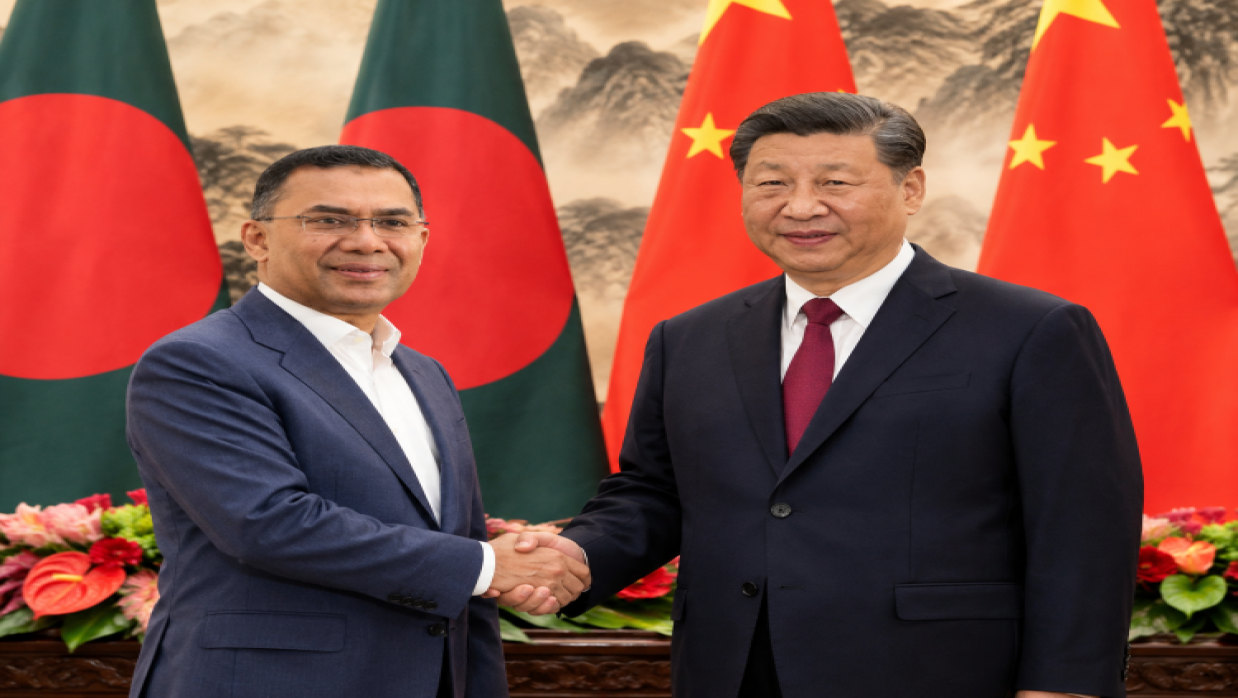
Prime Minister Tarique Rahman and Chinese President Xi Jinping exchange a symbolic handshake, reflecting a new chapter in Bangladesh–China relations. The engagement underscores expanding opportunities for strategic cooperation in trade, technology, infrastructure, and regional diplomacy as both nations seek to shape a more connected and prosperous Asian future.
“The future belongs to those nations that can build bridges of cooperation while preserving their independence of choice.”
The upcoming visit to China by Prime Minister Tarique Rahman comes at a crucial time for Bangladesh and the international community as a whole. In an era marked by heightened tensions among the world’s superpowers, economic uncertainty, and constant technological change, Bangladesh and China now find themselves in a unique position to elevate their already strong relationship to a new level of importance.
While the two countries have enjoyed strong bilateral relations built on respect, economic collaboration, and a common vision of growth over the years, the reality of the twenty-first century offers a chance to expand their existing scope of cooperation into such areas as trade, technology, innovation, education, environmental issues, and digital transformation.
Thus, Prime Minister Tarique Rahman’s upcoming visit holds importance far beyond that of any ordinary state visit.
A Relationship Built on Strong Foundations
Since the establishment of diplomatic relations in 1975, Bangladesh and China have steadily expanded cooperation across a wide range of sectors. What began primarily as political and economic engagement has gradually evolved into a multifaceted partnership that includes trade, infrastructure development, defense cooperation, cultural exchange, and people-to-people connectivity.
China is now seen as one of Bangladesh’s leading trade partners and a significant player in providing financing and making infrastructure investments. There are many such examples in sectors such as transport, power generation, telecommunications, and industrial development.
More importantly, China and Bangladesh have shown a strong capacity to maintain stable relations amid changing international conditions. It has led to trust that now serves as a very good basis for more strategic collaboration. Prime Minister Tarique Rahman’s visit offers an opportunity not only to strengthen this legacy but also to adapt it to the demands and opportunities of a rapidly changing world.
From Pragmatic Engagement to Strategic Partnership: Building on the Yunus Legacy
The strengthening of Bangladesh–China relations in recent years owes much to the pragmatic and development-oriented leadership of Nobel Peace Laureate Dr. Muhammad Yunus. During his tenure as Chief Adviser, Dr. Yunus emphasized economic diplomacy, international cooperation, and diversified global partnerships aimed at advancing Bangladesh’s development priorities rather than becoming entangled in geopolitical rivalries. His engagement with Chinese leaders, development institutions, businesses, and educational organizations helped reinforce mutual trust and expand avenues for cooperation in areas such as trade, investment, social business, renewable energy, agriculture, healthcare, education, and youth development. By pursuing a balanced foreign policy rooted in national interests, Dr. Yunus contributed to creating a stable and constructive foundation for deeper Bangladesh–China engagement.
Building upon that foundation, Prime Minister Tarique Rahman has the opportunity to elevate bilateral relations to a new strategic level. His anticipated engagement with China signals continuity in Bangladesh’s commitment to constructive cooperation while introducing fresh opportunities for collaboration in advanced manufacturing, artificial intelligence, digital transformation, infrastructure modernization, climate resilience, connectivity, and human capital development. Rather than representing a departure from previous policies, Prime Minister Rahman’s outreach to Beijing can be viewed as a continuation of a pragmatic diplomatic approach that seeks mutually beneficial outcomes for both nations. Together, the efforts initiated under Dr. Yunus and expanded under Prime Minister Tarique Rahman have the potential to transform Bangladesh–China relations into one of Asia’s most dynamic partnerships, driven by shared development goals, economic prosperity, regional stability, and a common vision for a more interconnected future.
From Infrastructure to Industrial Transformation
One of the areas in which Bangladesh and China have collaborated since time immemorial is infrastructure development. Infrastructure such as roads, bridges, port facilities, and power stations has been instrumental in helping modernize Bangladesh.
Yet the next stage of cooperation may require a shift in focus from building physical infrastructure to accelerating industrial transformation and value-added production.
Bangladesh has already demonstrated impressive achievements in ready-made garments, pharmaceuticals, and agricultural production. However, sustaining long-term growth and achieving upper-middle-income status will require greater industrial diversification, technological upgrading, and innovation-driven development.
China’s expertise in modernizing manufacturing operations, industrial clusters, logistics management, and export-led development is valuable to Bangladesh and offers an opportunity for the country to learn from China’s experience. Increased investment from China in the advanced manufacturing sector, renewable energy, electronics, auto parts, and knowledge-based industries can help Bangladesh develop its industry and create better jobs for its growing population. Special economic zones and industrial estates developed through collaboration between both countries can become hubs of innovation, efficiency, and excellence in industry.
Expanding Trade Beyond Traditional Boundaries
Trade remains one of the strongest pillars of Bangladesh–China relations, yet significant untapped potential persists.
Although Bangladeshi exports to China have increased steadily over the years, the bilateral trade relationship remains marked by a substantial imbalance. Addressing this challenge will require strategic efforts to diversify Bangladesh’s export portfolio and expand access to Chinese markets.
Prime Minister Tarique Rahman’s visit could open new avenues of cooperation in sectors such as:
- Agricultural products
- Pharmaceuticals
- Information technology services
- Leather goods
- Jute and diversified jute products
- Light engineering industries
- Creative and cultural industries
Greater market access for Bangladeshi products would contribute to a more balanced trade relationship while supporting the country’s broader export diversification agenda. At the same time, enhanced logistics networks and digital trade platforms could significantly improve commercial connectivity between the two nations.
Technology and the Digital Future
Among all potential areas of cooperation, technology and digital innovation may hold the greatest transformative potential.
Today’s global economy is increasingly driven by artificial intelligence, advanced manufacturing, robotics, cloud computing, biotechnology, big data analytics, and digital services. Nations capable of integrating these technologies into their development strategies are likely to gain significant competitive advantages in the decades ahead.
However, Bangladesh has made significant strides in digital government, fintech, mobile connectivity, and information technology entrepreneurship. There is still plenty of potential for fostering innovation-driven growth.
The advances of China in technology make room for collaboration in spheres such as:
* Research in artificial intelligence
* Smart city initiatives
* E-commerce systems
* Digital infrastructure
* Green technologies
* Telecommunications
* Academic cooperation
* Research and development projects
By promoting technology transfer, research collaborations, and innovation ecosystems, Bangladesh and China may establish a collaboration that focuses more on the future than on traditional development collaboration.
Education, Knowledge Exchange, and Human Capital Development
No nation can achieve sustainable development without investing in its people.
As Bangladesh aspires to become a knowledge-based economy, education and research cooperation should occupy a more prominent place within the bilateral agenda.
Universities, research organizations, and professional training centers have a strong capacity to build stronger relations between the two nations. Scholarships, faculty exchange programs, research programs, language training programs, and innovation centers can help build the right kind of workforce needed for future economic development.
Apart from these organizational advantages, educational collaborations can also serve as a means of developing a better understanding and mutual respect amongst the next generation of leaders, academicians, professionals, and entrepreneurs.
Climate Change and Sustainable Development
Climate change remains one of the defining challenges of our time, and Bangladesh stands among the nations most vulnerable to its consequences despite contributing relatively little to global emissions.
At the same time, China has emerged as a global leader in renewable energy technologies and green infrastructure development.
This convergence of interests creates significant opportunities for cooperation in:
- Renewable energy generation
- Climate adaptation technologies
- Sustainable agriculture
- Water resource management
- Disaster preparedness
- Green transportation
- Environmental innovation
Efforts made by both countries in these fields would make Bangladesh more resilient while also contributing to sustainability at the regional and global levels. Considering that environmental issues continue to drive global policies, climate cooperation could be one of the cornerstones of future Bangladesh-China relations.
Navigating Geopolitical Complexities
However, any discussion of Bangladesh-China relations will be incomplete without considering the wider geopolitics of the modern age.
The South Asian and Indo-Pacific regions have emerged as centers of great-power competition. It is only natural that Bangladesh, an emerging economy of considerable importance, should draw considerable international attention.
Throughout its history, however, Bangladesh has pursued a pragmatic and balanced foreign policy rooted in sovereignty, national interest, and constructive engagement with all partners.
Prime Minister Tarique Rahman’s visit should therefore be viewed within this broader context. Strengthening relations with China does not require weakening ties with India, the United States, Japan, the European Union, ASEAN member states, or other international partners.
On the contrary, the visit could affirm Bangladesh’s continued pursuit of diverse alliances that support its development aspirations without compromising strategic independence. This balanced policy has been very useful for Bangladesh in the past and will remain relevant for it even in a multipolar world order.
Vision for Regional Connectivity
One of the most promising areas for future collaboration is regional connectivity.
Improvements in transportation infrastructure, trade routes, maritime cooperation, and digital infrastructure can contribute to the economic integration of Asia.
Situated strategically between South Asia and Southeast Asia, Bangladesh can serve as a bridge connecting the world’s most dynamic regions. Improved connectivity can lead to increased trade, foreign investment, tourism, and cultural exchange.
In this way, the discussions between Prime Minister Tarique Rahman and his counterpart during his visit to Beijing can have consequences that extend beyond bilateral ties and help shape a vision of a connected and prosperous Asia.
China Before India: The Strategic Significance of Diplomatic Sequencing
One of the most important elements of the prime minister’s expected foreign trips would be the diplomatic message conveyed through the order in which the bilateral visits take place. If Prime Minister Tarique Rahman chooses to visit China among the earliest of his destination countries before a state trip to India, this action would surely draw significant attention from diplomats, policymakers, and regional experts.
The order of state visits in international diplomacy is often important, beyond protocol, in conveying certain diplomatic messages about a country’s strategic orientation and interests.
It could be seen as an attempt by the new government to diversify its international relations while broadening its options.
This trend, however, does not imply any abandonment of the long-standing relationship between Bangladesh and India. The geographical location, historical ties, cultural ties, economic and commercial cooperation, water resources, border management, and regional security concerns will keep both countries as partners of utmost importance to each other.
At the same time, a China-first diplomatic engagement could reflect a more confident and multidimensional foreign policy—one that seeks constructive engagement with all major powers based on mutual interests, economic opportunities, and strategic autonomy.
In terms of Beijing’s views on this matter, an early visit by Prime Minister Tarique Rahman could be well received as an indication of Bangladesh’s readiness to further develop cooperation in investment, industrialization, technology transfer, renewable energy, connectivity, and digitalization.
For India, this visit could intensify the geopolitical competition in South Asia, especially given Bangladesh’s continued economic growth and rising strategic importance, as well as the growing willingness of global powers to establish closer ties with the country.
Certainly, the increased competition between the two countries, if handled wisely, may help the country attract more investment, gain market access, secure technology transfers, and receive development cooperation.
Considering the country’s long-term interests, it is more important to deal with both countries than to choose one over the other. Therefore, the visit of Prime Minister Tarique Rahman to China before visiting India holds a lot of importance for the country.
The real importance of diplomatic sequencing lies not in division but in opening doors. If this strategy is applied wisely, visiting China before other places could strengthen the country through better negotiations and increased influence in the region. It should be noted that what will really matter is not the order in which the capitals are visited, but the effectiveness with which Bangladesh’s international relations have been utilized.
Looking Ahead
The real importance of Prime Minister Tarique Rahman’s visit to China shall only be seen from the results that follow and not from any ceremony or statements made during the visit.
Over the past five decades, Bangladesh–China relations have matured into one of the most consequential bilateral partnerships in Asia. Yet the greatest opportunities may still lie ahead.
If approached strategically, the next phase of cooperation can transcend infrastructure financing and evolve into a comprehensive partnership centered on innovation, industrial development, technological advancement, human capital formation, sustainable development, and regional connectivity.
In times of global uncertainty, Bangladesh and China have the chance to show how respect and cooperation can make a difference for both countries.
Prime Minister Tarique Rahman’s visit may well mark the beginning of a new chapter—one in which Bangladesh–China relations evolve from a successful partnership of the past into a transformative strategic relationship for the future.
Conclusion
Now is the time to chart a new era in the annals of bilateral ties between Bangladesh and China. The demands of the contemporary era – like economic transition, technological advancements, global warming, and geopolitical uncertainties – mean that alliances should be visionary and flexible.
Prime Minister Tarique Rahman’s visit to China presents an opportunity for out-of-the-box thinking on collaboration between the two countries. With mutual respect, common interest, and sustainable development at heart, such an endeavor can not only strengthen the relationship between Bangladesh and China but also ensure prosperity in the region.
Considering the prospects for further development amid globalization and regionalization, one should no longer ask whether Bangladesh and China will cooperate. What matters is how innovative and visionary this cooperation will be in the future.

Dr. Serajul I. Bhuiyan
Dr. Serajul I. Bhuiyan is a Professor and former Chair of the Department of Journalism and Mass Communications at Savannah State University.